
Every employee permission is a switch, and there are more than a hundred of them, grouped on the contact form as Miscellaneous, Orders, Reports, Integrations and Notifications (plus Operator on shops that have it). Set the baseline once on your own company so every employee starts with what most people need, then Allow or Deny individual switches on the people who need more or less. Administrators pass every check and can't be restricted. This article explains how the layers work, then lists each permission and what it unlocks.
Applies to: employees who manage staff access. Seeing and changing the boxes needs Modify permissions; changing the company-wide baseline also needs Add/edit companies. Customers and vendors have their own, smaller set of boxes: Understanding what your customer sees.
In this article
- How access works
- Miscellaneous
- Orders
- Reports
- Integrations
- Notifications and Operator
- Things to know
How access works
- Three states per box. On a person's contact form (and on the company form) each permission is Allow (tick), Deny (cross) or blank. Blank means "inherit": the person gets whatever the next layer gives. The box's shading shows what blank would give.
- Three layers. A person's own Allow or Deny wins. If their box is blank, your company's setting decides. If that is blank too, Allmoxy's default for the company's role (Employer for your own company) decides.
- Set the baseline on your company. Open your own company's edit page and set the boxes there to what most employees should have. Then on each person, change only the exceptions. That keeps a new hire's permissions predictable: set their boxes before they first sign in.
- Administrators. Administer the entire site passes every permission check, opens the administrator-only pages (Admin Settings, Hijack, deleted records, the administrator account) and can't be restricted: a Deny on an administrator does nothing. It isn't shown in the editor; ask Allmoxy support if you need another administrator.
- A box you can't see means none of the company's roles can hold that permission (a vendor-only company, for example).
- Changes apply on the next page, except Operator and the AI order importer, where the person needs to log out and back in.
Worked example: your company has Manage Supply Locations set to Deny for everyone. Dana, your shipping lead, has her own Allow on it. Dana can open Settings > Operations > Shipping and Supply Locations; nobody else can. If Dana lacks Edit the site settings., the Shipping entry isn't in her Settings menu even though the page opens for her, so give her both.
Miscellaneous
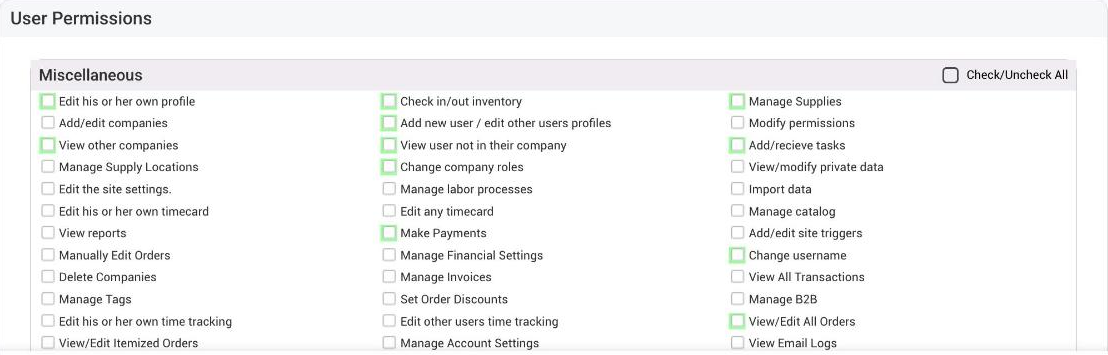
The boxes as they appear on screen, in alphabetical order. Your shop may show one or two more or fewer than this list.
| Permission (as shown on screen) | What it lets them do |
|---|---|
| Add new user / edit other users profiles | Add contacts at any company and edit anyone's profile; opens the Contact Updater; shows the Add Contact buttons and the company picker on the contact form. |
| Administer the entire site | Not shown in the editor. Passes every check; see How access works above. |
| Add/edit companies | Add new companies and edit any company (name, about, tags). Deleting is separate (Delete Companies). Also needed, with Modify permissions, to change your company-wide permission baseline. |
| Add/edit site triggers | Open and edit Settings > Operations > Triggers. |
| Add/recieve tasks | Create tasks and be assigned tasks; only people with this appear in the Assign To list and as trigger recipients. (The spelling on screen is "recieve".) |
| Allow Public Notes | Choose Anyone as the visibility of a note, instead of only Private or My Company. |
| Change company roles | Tick a company's roles (Customer, Vendor and so on) on the company form, for example to turn a vendor into a customer. |
| Change username | Set or change someone else's username, password and Allow this person to log in. Without it those fields are locked when editing another person. |
| Check in/out inventory | Open the Checkout/Order page and mark supplies in and out; adds Purchase Orders, Purchase Batches, Checkout/Order and PO Queue to the Supplies menu. Does not let them manage supplies or locations. |
| Collections | Open the Collections report (Financial). It sits in this group on screen rather than under Reports. |
| Create Announcements | Post announcements. |
| Delete Companies | Delete a company (never your own). Deleting is refused once a company has orders, invoices, supplied items or subscriptions. |
| Edit any timecard | Edit everyone's time cards, open Financial > Timecard Management and print time cards. Typically a manager or lead: Manage time cards and the payroll report. |
| Edit closed POs | Change quantities and unit prices on a purchase order that has been fully received. |
| Edit his or her own profile | Edit their own contact page (name, photo, signatures) and open Manage Profile. |
| Edit his or her own time tracking | Edit their own job time entries (the Time Tracking dialog and report). This is job time, not the time card. |
| Edit his or her own timecard | Edit their own time card entries. |
| Edit open POs | Change quantities and unit prices on a purchase order that is not yet fully received. |
| Edit other users time tracking | Edit anyone's job time entries and see everyone's rows on the Time Tracking report, with the date and employee filters. |
| Edit the site settings. | Open Theme (Settings > Admin), Merge Companies (Settings > Utilities) and Order Settings (Settings > E-commerce). It also shows the Shipping and Exporters menu entries, but those pages need Manage Supply Locations (below). |
| Import data | Open the Import page (Settings > Utilities) and import data. |
| Make Payments | Make payments for the company; shows the Outstanding Invoices section and balance on a company page. |
| Manage Account Settings | Open Settings > Admin > Account Settings, your Allmoxy subscription: Manage your Allmoxy subscription and billing. |
| Manage Announcements | Edit and remove announcements. |
| Manage B2B | Open the B2B and Marketplace settings, link a remote company and sell in the marketplace. |
| Manage catalog | Open everything under the catalog: products, categories, attributes, components, export classes, output pages, proxy variables and the B2B catalog: Guide: Building your catalog. |
| Manage Custom Fields | Open Settings > Operations > Custom Fields. |
| Manage Financial Queues | Open the Invoices, Sales Orders and Credit Memos export queues and the Invoice Batches page. |
| Manage Financial Settings | Open Financial Settings, price adjustments, coupons and tax codes; edit the Financial Settings section on a company (payment term, credit limit and so on); undo a transaction or flag a bounced check; manage anyone's saved payment methods. |
| Manage Invoices | Create credit memos, email and void invoices, run batches and statements; see other companies' invoices. |
| Manage labor processes | Open Settings > Operations > Labor Processes and production lines: Create production lines in Allmoxy. |
| Manage Supplies | Open the supplies list, editor and updater, purchase orders and the Received Supplies report. Give Manage Supply Locations too if they manage locations. |
| Manage Supply Locations | Open Settings > Operations > Supply Locations, and also the Shipping and Exporters settings pages and the Save button on a supply. Turning it off locks the person out of shipping and exporter settings as well as locations. |
| Manage Tags | Rename and delete tags on Settings > Utilities > Manage Tags, and edit the tags on companies, contacts, products, supplies and orders (without it tags are shown read-only): Tags: group customers, orders and products. |
| Manually Edit Orders | Open the Order Override tab and override prices, tax and shipping on an order that hasn't shipped. |
| Modify permissions | See and change the permission boxes on anyone's contact page and on a company. With Add/edit companies, change the company-wide baseline. |
| Payment Terms | Open Settings > Operations > Payment Terms and edit a term from a company or order page. |
| Set Order Discounts | Edit the Discount Percent field on an order. |
| View All Transactions | Open Financial > Payment Receipts, the list of every payment from every company. |
| View Email Logs | Open the email log (what Allmoxy sent and to whom). The report version also needs View other companies. |
| View other companies | Open the companies list and any company's page. Turn it off to keep someone away from your customer base; they can still see your own company. |
| View reports | Open the Reports menu at all. Each report has its own switch too (Reports group below); with this off, no reports open, financial ones included. |
| View system-wide B2B announcements | See announcements generated by B2B issues. |
| View user not in their company | Open the Company Contacts and Individual Accounts lists. |
| View/Edit All Orders | Open orders other people entered, and choose the company and contact on a new order. |
| View/Edit Itemized Orders | Create and open itemized orders; shows the New Order button on a company page. |
| View/modify private data | See and change the Employee Information section (hourly wage, weekly salary) on an employee's contact page. |
Orders
| Permission | What it lets them do |
|---|---|
| Create Bids | Open and work on orders as bids: the Order, Discover, Design, Timeline and production line tabs and the duplicate, delete, import, tag, ship and start actions. With this but not Submit Orders, the status list offers only Bid and the order's current status. |
| Edit verified orders | Keep editing and saving an order after it is Verified, In Progress, Completed, On Hold, Shipped or Void. Without it those orders are read-only. |
| Order Batching | Open Orders > Batch Orders. |
| Resource Allocation | Open the Resource Allocation tab (Purchasing on project orders). |
| Submit Orders | Place and submit orders for customers: shows the Submit Order button and the statuses beyond Bid (Ordered, Verified, In Progress, Completed, On Hold, Shipped, Installed, Void), keeps Ordered orders editable, and shows Request a Remake once shipped. The Production pages need this or Create Bids. |
| View Cutlist | Open the parts-type output pages and export part lists. |
| View Invoice | Open the invoice-type output pages and print invoices (another company's invoice also needs Manage Invoices). |
| View Job Results | Open the Results tab on an order. |
| View Packing | Open the packing list for an order. |
| Use Import Tool | Open the AI order importer (shops with the Import Tool module). Starts out allowed; Deny on a person switches it off. |
Reports
View reports (Miscellaneous) opens the Reports menu; each report below then needs its own switch as well. Turning off View reports hides every report, financial ones included. Turning View reports on and one report's switch off hides only that report. The reports themselves: Guide: Reports in Allmoxy.
| Permission | Report it opens |
|---|---|
| Activity | Activity log (Managerial) |
| Allocated Supplies | Allocated Supplies (Production) |
| Average Payment Days | Average Payment Days (Financial), and the link on a company page |
| Customer Product History | Customer Product History (Production), and Show Buying History on a company page |
| Discounts | Discounts (shown on shops that have it) |
| Installation | Installation (Production; shops with project orders) |
| Material Cost by Customer | Material Cost by Customer (Financial) |
| Material Cost by Product | Material Cost by Product (Financial) |
| Notes Per Employee | Notes Per Employee (Production) |
| Orders | Orders (Production) |
| Order Results Comparison | Order Results Comparison (Managerial) |
| Products by Status | Products by Status (Production) |
| Projection | Projection (Managerial) |
| Purchase Order | Purchase Orders (Financial), and the Remote Receipts page |
| Remake | Remakes (Production) |
| Resource Allocation | Resource Allocation (Production) |
| Sales by Attribute | Sales by Attribute (Financial) |
| Sales by Customer | Sales by Customer (Financial), and the link on a company page |
| Sales by Product and Attribute | Sales by Product and Attribute (Financial) |
| Sales by Product | Sales by Product (Financial) |
| Sales Tax | Sales Tax (Financial) |
| Schedule Capacity | Schedule Capacity (Production) |
| Shipping | Shipping (Production) |
| Supplies in Use | Supplies In Use (Production) |
| Supply Movement | Supply Movement (Production) |
| Trigger Call Log | Trigger Call Log (Managerial) |
| View Aging Report | Aging (Financial) |
| View Current Inventory | Current Inventory (Managerial) |
| View Employee Productivity | Employee Productivity (Production) |
| view employee timecards | Employee Timecards and Work Log (Financial) |
| View Inventory In Use | Inventory in Use (Managerial) |
| View Inventory Usage | Inventory Usage (Managerial) |
| View Invoices | Invoices (Financial) |
| View Process Details | Process Details (Production) |
| View Production Report | Production (Production) |
| view received orders | Received orders |
| view sales by export class report | Sales by Export Class (Financial) |
| View Status History | Status History (Production) |
| View Task | Tasks (Managerial) |
| View Transaction Report | Transaction History (Financial) |
| view volume by customer report | Status Volume (Production) |
| View Work Schedule | Work Schedule (Production) |
| View Work Summary | Work Summary (Production) |
Integrations
| Permission | What it lets them do |
|---|---|
| Manage Accounting | Shows the Accounting entry under Settings > Integrations; opening the page also needs Manage Integrations. |
| Manage API key | Regenerate the API token and manage contact keys on the API settings page (the page itself needs Manage Integrations); with Modify permissions, set a contact's API access. Shown only when your shop has the API module. |
| View API key | See the API settings and keys without changing them. API module only. |
| Manage Designer | The Designer settings, on shops with the Designer module. |
| Manage Extensions | Open the Extensions page, which adds custom scripts to your shop. Allmoxy doesn't support custom scripts; leave this off unless you know you need it. |
| Manage Integrations | Open the API and Accounting settings pages, and add schedules and schedule events. |
| Manage Sendgrid | Open Settings > Integrations > Messaging (your email sending setup). |
| Manage Zapier key | Open Settings > Integrations > Zapier and generate the Zapier key. |
| View Zapier key | See the Zapier settings and the current key without generating a new one. |
Manage Sendgrid appears twice in this group on screen; both boxes are the same switch.
Notifications and Operator
| Permission | What it lets them do |
|---|---|
| Receive Supply Order Emails | Shown on contacts at vendor companies: who gets the emails when you order supplies from that vendor. |
| Use Operator | Open Operator (shops with the Operator module). Starts out allowed for everyone; set Deny on a person to switch it off for them: Guide: Operator. |
| Manage Operator | Operator's settings, on shops with Operator. |
The Operator group appears only on shops that have the module; Use Import Tool sits in the Orders group.
Things to know
- Person beats company beats default. A tick on the person wins even when the company says Deny.
- Administrators can't be restricted. Deny does nothing to them.
- View reports is the master switch for reports. Off means no reports at all.
- Manage Supply Locations also gates Shipping and Exporters. Edit the site settings only shows their menu entries.
- Submit Orders vs Create Bids. Bids only can open and build orders; Submit Orders is what moves them past Bid.
- A view-only login. For someone who should look at orders but not change them, Allow View Invoice (and View Cutlist if they need part lists) and View/Edit All Orders so they can open orders other people entered, and Deny Create Bids, Submit Orders, Edit verified orders and Manually Edit Orders. They see each order through its output pages. To let them see bids too, turn on Allow Output Pages in Bid Status at Settings > Admin; that switch is shop-wide, so your customers can then open output pages on their bids as well.
- Time cards and job time are different switches. "Timecard" is the clock in and out record; "time tracking" is job time on an order.
- Keep Manage Account Settings, Modify permissions and Manage Financial Settings to a few people. They control the subscription, everyone's access and your money settings.