
Financial settings live at Settings > Admin > Financial. They hold your payment gateway, shop-wide defaults, fees, finance charges and statement layout. Where a setting and a payment term disagree, the payment term wins.
Applies to: anyone with the Manage Financial Settings permission, which only the account owner has by default.
In this article
Payment Gateway Settings
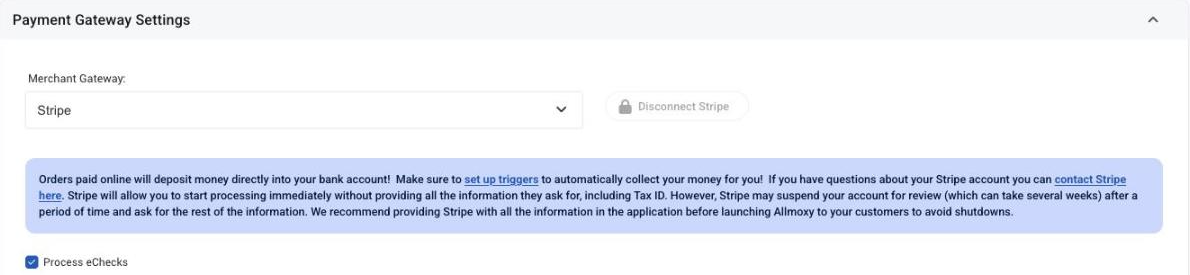
- Merchant gateway: the service your customers pay through. Choose Stripe. With None, customers can't pay online but your team can still record payments. See Set up Stripe.
- Connect Stripe / Disconnect Stripe: links or unlinks your Stripe account.
- Process eChecks: lets customers pay by bank account. See Accept bank (ACH) payments.
Financial Order Settings
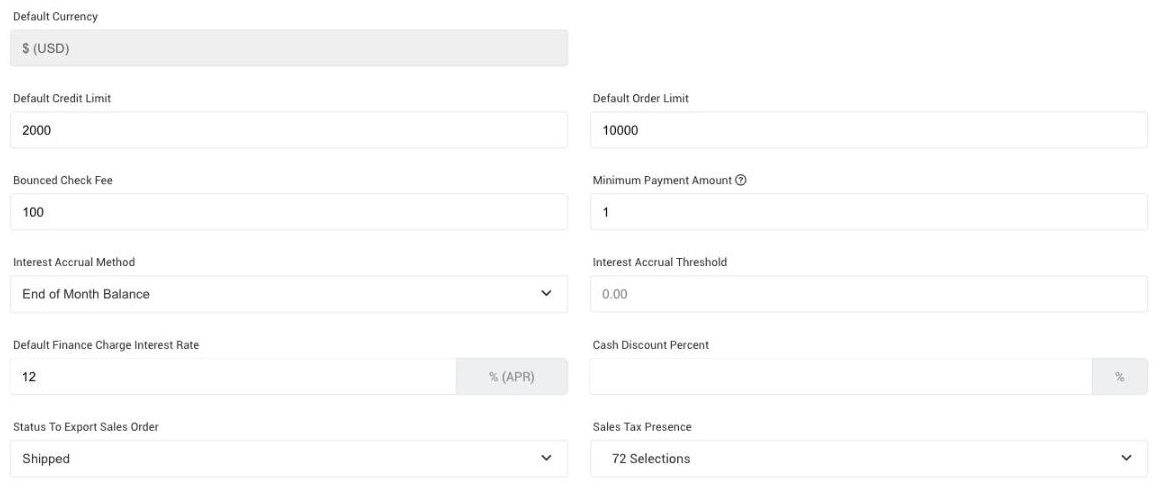
- Default Currency: can't be changed once set.
- When and how a customer pays is set by their payment term, not here. See Create and assign payment terms.
- Default Credit Limit and Default Order Limit: the defaults for any company that doesn't have its own. The order limit is sometimes called the build limit.
- Minimum Payment Amount: the smallest payment shown in the payment screens.
- Bounced Check Fee: the default fee when you mark a check as bounced.
- Cash Discount Percent: the discount your team can apply when recording a cash or check payment.
- Default Finance Charge Interest Rate (% APR): your annual rate, divided by 12 for each month. A company can have its own rate.
- Interest Accrual Method and Interest Accrual Threshold: how finance charges build up, and the amount at or under which a charge is skipped.
- Status To Export Sales Order: the status at which an order enters the Export Sales Orders Queue for your accounting export (Verified, In Progress, Completed or Shipped; None hides the queue). See The export queues and what is in the invoice CSV.
- Sales Tax Presence: the states where you collect sales tax. Your home state is selected automatically. Tick more states as needed. See Sales tax: where you collect it and how Allmoxy works out the rate.
Invoice Export
- Export mode: Detailed Invoices or Generalized Ledgers. This setting is not released yet and is visible only to Allmoxy administrators; every shop exports Detailed Invoices.
Statement Editor
Sets the layout of customer statements, with variables you can drop in. See Customer statements and aging.
Other sections
The page also holds Banks and these sections:
- Job Costing: works out your overhead per order in reports. Enter your default markup percentage and your average monthly labor hours so Allmoxy can allocate overhead costs.
- Payroll: your pay period length, the day each pay period starts and the payroll tax percent you pay on top of hourly wages, for timecards. See Manage time cards and the payroll report.
- Overhead Management: recurring overhead expenses that aren't tied directly to product labor and materials.