
Output pages are the documents Allmoxy builds for every order: the invoice and quote your customer sees, the part lists and cut sheets your shop works from, and product labels. Each one is a layout you design once, with variables such as the order number, addresses and totals that fill in for each order. On an order they appear as tabs across the top (or in Part Lists and Order Documents menus when folders are on). Your site starts with an Invoice, a Packing Slip and an All Parts page; change them, delete them or add as many as you like.
Applies to: anyone who sets up or maintains order documents. Editing output pages needs the Manage Catalog permission. Pages live under Settings (gear) > E-commerce > Output Pages.
In this article
- Where output page settings live
- The three page types
- Page settings, one by one
- Attributes and parts: what prints where
- Order, folders and the printed look
- Troubleshooting
Where output page settings live
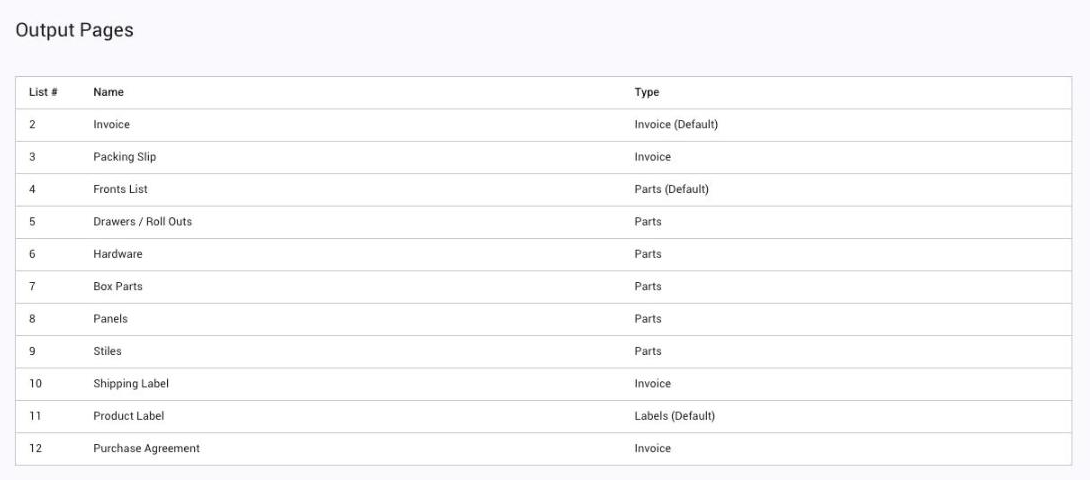
Output pages are controlled in three places, and most "why is this showing" questions come down to which one you are looking at:
- The page itself (Settings > E-commerce > Output Pages): the type, the layout, the on/off settings below and who can see it.
- Each attribute (Settings > E-commerce > Product Attributes, then open the attribute): at the bottom, a Show on checkbox for every output page. An attribute checked here shows on that page for every product that uses it.
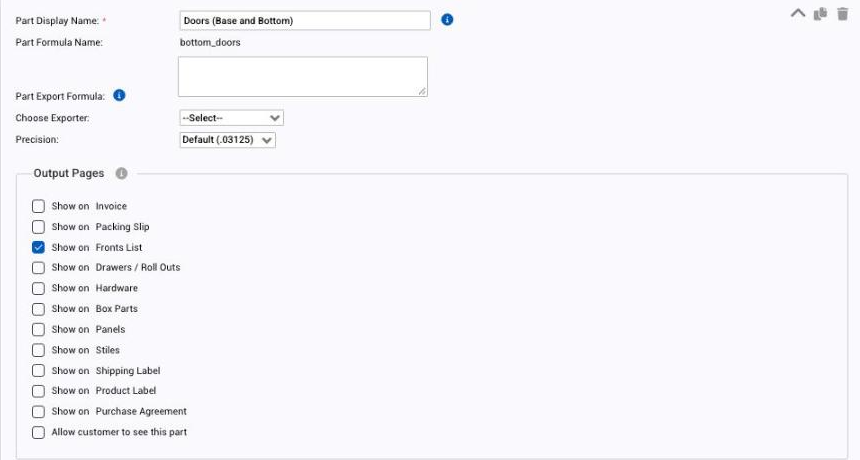
- Each part (Settings > E-commerce > Products, open the product, Parts tab, open the part): a Show on checkbox for every output page, plus a hide checkbox on each of the part's own attributes.
Tip: to build a new invoice or part list, copy the HTML of an existing page into the new one and start from there.
The three page types
Output Page Type decides when a page appears and who can open it:
- Invoice pages show on every order and are built for pricing. Customers need the View Invoice permission to open one.
- Part List pages show only when at least one part on the order is set to show on them. Customers need View Cutlist.
- Labels pages print one label per item and are only ever shown to employees. See Labels.
There is also a B2B Dropshipping Invoice type for drop-ship orders from the B2B marketplace.
Default page. One page of each type is the default. The default Invoice is where a customer lands when they open an order, and it is the page attached to the shipped-order email, so it must be visible to customers. You cannot untick the last default of a type; saving puts it back.
Output pages are hidden while an order is in Bid unless Allow Output Pages in Bid Status is on in Order Settings.
Page settings, one by one
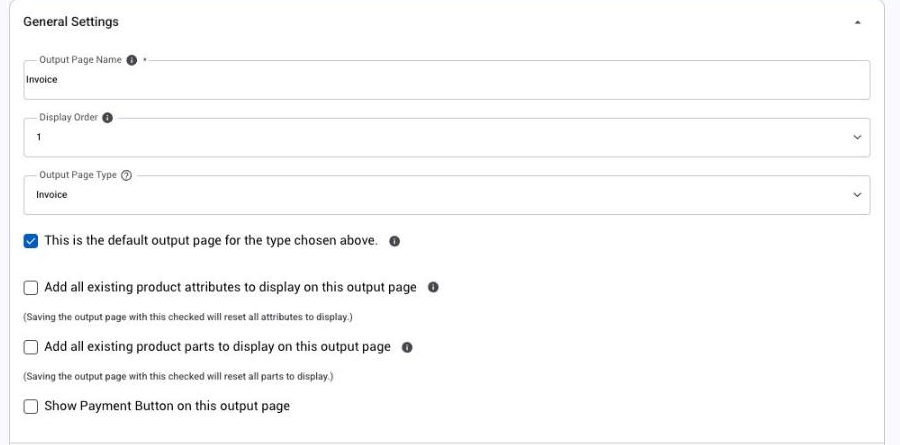
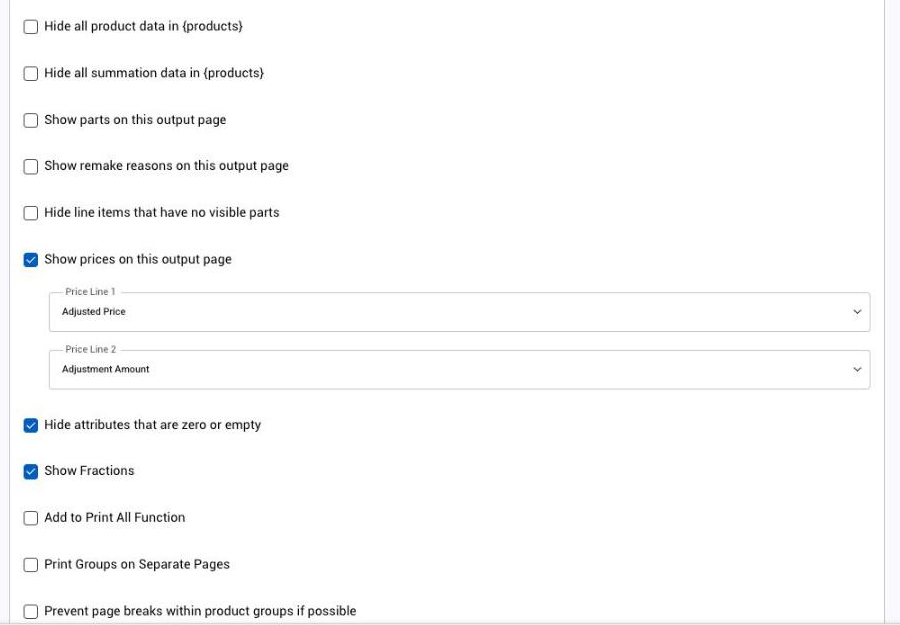
Open a page and work down the sections. You do not need to get these right first time; adjust them after you have seen real orders.
General Settings
| Setting | What it does |
|---|---|
| Output Page Name | The tab label on the order. |
| Display Order | 1 to 10. Lower numbers appear first across the order's tabs. |
| Output Page Type | Invoice, Part List, Labels or B2B Dropshipping Invoice (see above). |
| This is the default output page for the type | One default per type. |
| Add all existing product attributes to display on this output page | Ticks the Show on box for this page on every attribute when you save. The box unticks itself afterwards; the attributes stay set. |
| Add all existing product parts to display on this output page | The same for every part of every product. Be careful: on a page meant for one kind of part (stiles and rails, say) this puts every other part on it too. |
| Show Payment Button on this output page | Adds a Pay Now button after the products for customers who can make payments, once the order is past Bid and has a balance. |
Contents
| Setting | What it does |
|---|---|
| Hide all product data in {products} | Leaves product details out of the product list. |
| Hide all summation data in {products} | Leaves the totals rows out. |
| Show parts on this output page | Lets part data print. An Invoice page needs this ticked to show any parts; a Part List page shows them automatically. |
| Show remake reasons on this output page | Prints the remake reason on remake orders. |
| Hide line items that have no visible parts | Drops lines with nothing to print, which removes blank space. |
| Show prices on this output page | Lets pricing print. A Part List page needs this ticked to show prices; an Invoice page shows them automatically. |
| Price Line 1 and Price Line 2 | Which price prints on each line: Adjusted Price, Retail Price, Retail Price with Strike Through, Adjustment Amount or None. |
| Hide attributes that are zero or empty | Skips any attribute with no value or a value of 0. The closest thing to hiding information per order. |
| Show Fractions | Prints measurements as fractions instead of decimals. |
| Add to Print All Function | Includes this page when someone clicks Print All on an order. |
| Print Groups on Separate Pages | Starts a new printed page for each product group. |
| Prevent page breaks within product groups if possible | Keeps a group together rather than splitting it across pages. |
| Show product images on this output page | Prints each product's picture. |
| Show group attribute images on this output page | Prints images attached to group attributes. |
| Show Line Item Barcodes | Adds a scannable barcode to every line. |
| Show Order # in Footer | Prints the order number at the bottom of every printed page. |
| Show date/time in footer | Prints a date, time, or both at the bottom of every printed page. See Footer content. |
| Hide Page # in Footer | Removes the "Page 1 of 3" footer. |
| Hide notes field if empty | Skips the notes block when there are no notes. |
| Hide B2B items if any | Leaves B2B marketplace lines off the page. |
| Show folder name | Prints the order folder each product sits in. |
| Show itemized Order line item breakdown | On itemized orders, prints each Other Costs line with its description instead of one grouped line. |
| Number of items per page | Forces a page break after this many line items. |
| Product Font Size | 8px to 16px for the product and supply tables, which the editor cannot size on its own. |
Visibility
| Setting | What it does |
|---|---|
| Show this output page to customers | Customers can open, print and email the page. |
| Only Show to Customers with Tags | Limits the page to customers whose company carries one of the chosen tags. |
| Show this output page to employees | Your team can open it. Default pages and Labels pages are always visible to employees. |
PDF Options
| Setting | What it does |
|---|---|
| Page Orientation | Portrait or Landscape for the PDF and printed copy. |
| Condense for print | Tightens the spacing for a shorter printout. |
Label Options apply only to Labels pages and pages that use the {labels} variable; they are covered in Labels.
HTML is the layout itself, edited in the editor at the bottom of the page. Click into the editor where you want a variable, then click its name in the black sidebar and it is inserted, for example {order_num}. The Label Creator editor above it is for old-style labels and can be left empty.
Attributes and parts: what prints where
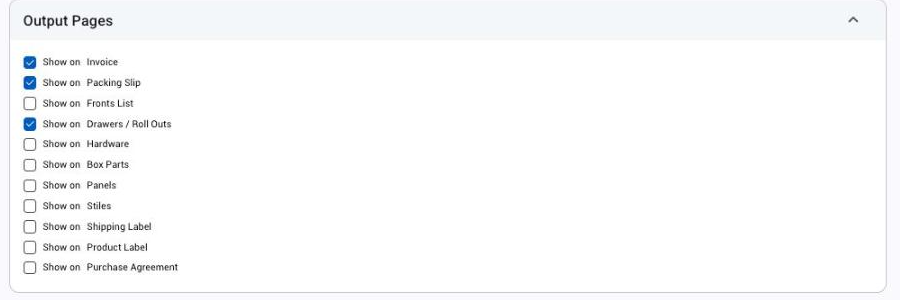
Attributes are the questions a customer answers (wood type, width, hinge drilling). Open an attribute and, at the bottom, tick Show on for each page it belongs on. The attribute then prints on that page for every product that uses it.
Parts are what a product is made of (sides, back, drawer fronts), each with its own quantity and size attributes. Open a product's Parts tab, open a part, and tick Show on for each page. Below that, each part attribute has a Hide attribute on the output page box, so you can print a part's quantity and width but not its length. The same part has an Allow customer to see this part box; without it the part prints for your team only.
A part that is not set to show on any Part List page means that page may not appear on the order at all.
Order, folders and the printed look
- Display Order on each page sets the tab order.
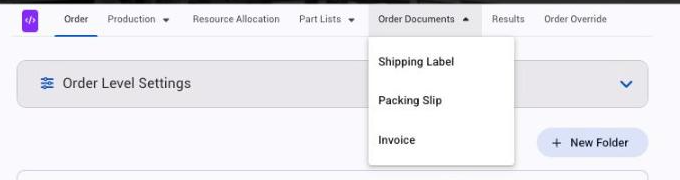
- Folders tidy a crowded order. Tick Use Output Page Folders in Settings > E-commerce > Order Settings and the tabs collapse into a Part Lists menu and an Order Documents menu.
- For column widths, spacing, sorting, images and page orientation see Format output pages.
Troubleshooting
Information is missing from a page. Check the attribute's Show on boxes, then the part's. On a Part List page at least one part in the product must be set to show. If one page shows the information and another does not, open both pages' settings side by side and compare. More cases are in Parts or products don't show.
A customer cannot open a page, or gets an error on their order. The default Invoice page is probably not set to show to customers, or the customer lacks View Invoice or View Cutlist. See Customers can't open an output page.
The PDF looks different from the screen. Printable PDF sends the page as your browser shows it. PDFs that Allmoxy builds for email, triggers and batch printing are rebuilt on the server without page scripts, so a layout that depends on a script can differ. PDFs are always light, even when the screen is in dark mode.
Things to know
- A misspelled variable prints exactly as typed. Compare it with the sidebar list.
- Print All needs every included page to share one orientation; mixed portrait and landscape give an error instead of a PDF.
- The Packing Slip under an order's documents and the payment receipt are fixed layouts, not output pages.
Watch: Configuring output pages (older screens, same settings)