
| What are output pages? | ⚙️→ Output Pages → Settings |
| Output page settings on attributes | Output page settings on parts |
| Troubleshoot output pages | Formatting on output pages |
Output pages are the supplemental documents created with an order. These typically include an Invoice, Parts List, and Packing Slip — but in Allmoxy you can create as many as you'd like.
They appear here on your orders:
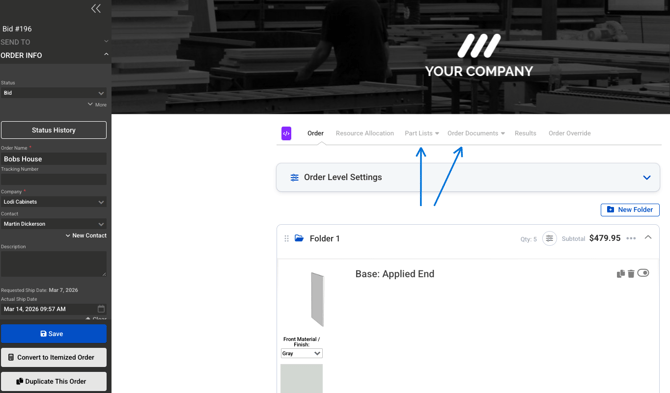
Your instance will start with a few pre-built pages to get you going: Invoice, Packing Slip, & All Parts pages. You're welcome to change, delete, or add to these anytime!
👍 If you want to create a new version of an invoice or parts list, we recommend copying the HTML from your existing Invoice page and pasting it into a new output page to give you a good starting point!
Get started by going to ⚙️ → E-Commerce → Output Pages.
Managing Output Page Settings
Each output page has a lot of settings — don't stress about getting everything perfect upfront. You can always come back and adjust as you see how pages look on real orders.
There are 3 places where output page settings can be managed:
- ⚙️ → Output Pages → Output Pages Settings
- At the product attribute level (⚙️ → E-Commerce → Product Attributes)
- In individual parts of products (⚙️ → E-Commerce → Products → Parts tab inside a product)
The Output Page Type setting has three options: Invoice, Part List, and Labels. Invoice-type output pages will always show on every order and include pricing information. Part List-type pages will only show on an order when there are parts set to show on it. Labels are used to create product-specific labels.
-
⚙️ → Output Pages → Settings
Each output page has several control settings that dictate the behavior of that specific page.
Inside each output page's settings, you'll find a Contents section with checkboxes that give you granular control over what information appears on that page. Here's a breakdown of the key settings:
Hide all product data in {products} — Hides all product-level data for the selected product type.
Hide all summation data in {products} — Hides any summary/totals rows for the selected product type.
Show parts on this output page — Enables part data to appear on the page.
⚠️ If your output page type is set to Invoice, you'll need to check this setting to display any product part data. It won't show automatically the way it does on a Part List-type page.
Show remake reasons on this output page — Displays remake reason information when applicable.
Hide line items that have no visible parts — Cleans up your output page by removing line items that have no associated part data to display. Great for reducing blank space and keeping things easy to read.
Show prices on this output page — Enables pricing information to appear on the page.
⚠️ If your output page type is set to Part List, you'll need to check this setting to reflect any pricing. It won't show automatically the way it does on an Invoice-type page.
Show weights on this output page — Displays product weight information when available.
Hide attributes that are zero or empty — Hides any attribute fields that have no value or are set to zero. Like hiding empty line items, this helps declutter your output pages and keeps them looking clean.
Show Fractions — Displays measurements as fractions rather than decimals.
Add to Print All Function — Includes this output page when a user clicks "Print All."
Print Groups on Separate Pages — Starts a new page for each product group.
Prevent page breaks within product groups if possible — Keeps product groups together on the same page rather than splitting them across a page break.
Show product images on this output page — Displays product images inline on the page.
Show group attribute images on this output page — Displays images attached to group attributes.
Show Line Item Barcodes — Adds a scannable barcode to each line item.
Show Order # in Footer — Displays the order number in the page footer.
Show date/time in footer — Select a timestamp format. This will apply when an output page is printed or emailed, giving you clear version control.
Hide Page # in Footer — Removes page numbers from the footer.
Hide notes field if empty — Hides the notes section when there's nothing in it, reducing unnecessary blank space.
Hide B2B items if any — Hides B2B-specific line items from the output page.
Show folder name — Displays the folder name associated with an order.
Show Itemized Order line item breakdown — See custom line items and prices from itemized orders.
Number of items per page — Sets a maximum number of line items per page before a page break is inserted.
Product Font Size — Lets you manually set the font size for product and supply data. (Because of the way products and supplies are structured, the editor can't adjust this automatically.)
💡 If you're looking to create order-level labels, check out creating labels in Allmoxy for a full walkthrough.
Visibility Settings
Dictate who can see each individual output page using these settings:
Show this output page to customers — When checked, customers can view, print, and email this output page from their side of the portal.
⚠️ If a customer gets an error when trying to view their order, it's possible that the default output page for that order type isn't set to visible for customers. This is one of the first things to check!
Show this output page to customers — Give or restrict the ability for your employees to see this page.
If you're looking to build labels in your output pages, visit this article.
HTML Editor
Use the WYSIWYG editor to customize the layout and populated data on your output pages! The black sidebar has a variety of variables that will pull company or order specific information on each page.
2. Output Page Settings on Attributes
The next step is to set your products to show on the pages you want them to appear on.
Attributes (the things that make up your products — wood type, profiles, sizes, etc.) can each be set to show or not show individually. Checking an output page at the attribute level means that attribute will always show on that output page, regardless of which product it appears on.
Open any attribute as if you were going to edit it, and toward the bottom of the page you'll see the option to show it on each output page.
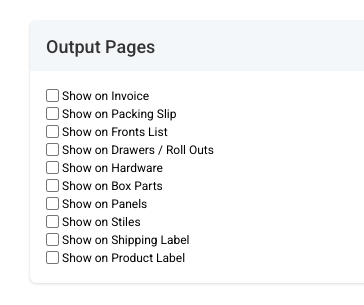
Select the output pages that you'd want this attribute to show on.
3. Output Page Settings on Parts
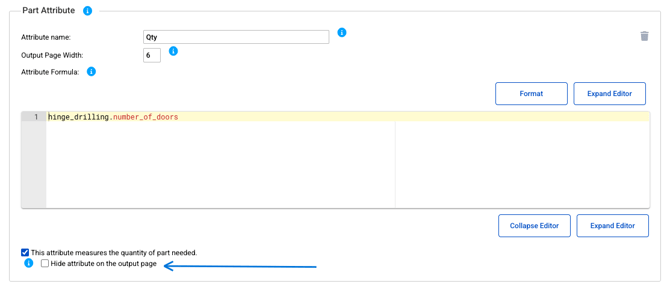
To configure your parts lists, you'll want to focus on the parts inside your products. Each part can have multiple aspects — or "part attributes" — attached to it. For example, a "Sides" part for a cabinet might include a qty, height, and width. You can choose to hide any of these on the part list if needed.
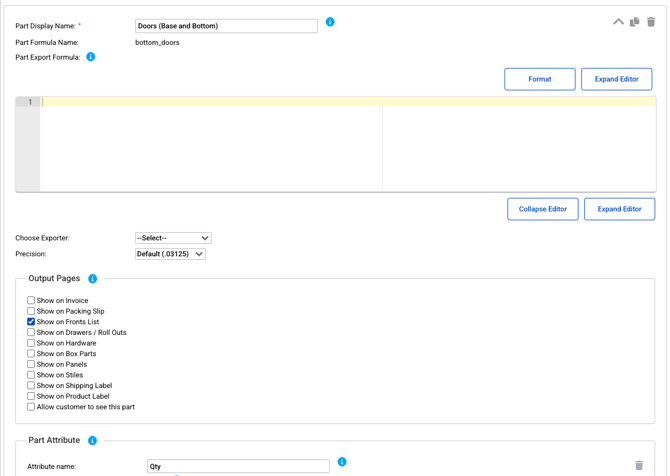
Each part can be set individually on output pages, and then each part attribute can be set to not show on the output pages, if you need some part information, but not every part attribute.
Part output page settings:
Individual part attribute settings:
Organize Your Output Pages
Priority Each output page has a priority score you can set. This determines the order the pages appear in on an order.
Folders If you'd like your order page to look less cluttered, you can use Output Page Folders. This groups all of your part lists-type pages under one dropdown: Parts Lists and all invoice-type pages under another: Order Documents
To turn folders on, go to ⚙️ → E-Commerce → Order Settings and select Yes on the Use Output Page Folders setting.
Troubleshoot Output Pages
Information isn't showing on an output page?
- Check that the relevant attributes are set to show on that output page.
- If it's a Part List-style page, confirm that at least one part in the product is assigned to show on that page.
- If one output page shows the correct information and another doesn't, open both pages' settings and compare them side by side.
Customers can't access an output page?
- Check that "Show this output page to customers" is checked on the output page.
- Ensure the customer has permission to View Invoices or View Cutlists.
- If the output page is a Part List-style page, go into the product and confirm that the "Allow customer to see this part" setting is selected on the desired part.
-1.png?width=670&height=403&name=Untitled%20design%20(11)-1.png)
If you're still having issues, contact your customer success manager!
Formatting Output Pages
Typically output pages (ESPECIALLY parts lists) need some configuring to get the page to look clean and clear. For assistance in configuring, review this article.