
An attribute is a question a product asks the customer: wood type from a dropdown, width as a number, a checkbox for hinge drilling. Attributes are shared definitions kept at Settings > E-Commerce > Product Attributes, so one Wood Type attribute can sit on every product that needs it, and each product can override it for itself alone. Pricing, parts and validations all read the customer's answers by the attribute's formula name.
Applies to: every shop with its own catalog. You need the Manage Catalog permission.
In this article
- The five types
- Group attributes and item attributes
- Display name and formula name
- Options and custom columns
- Overrides: change an attribute for one product
- Order-level settings
- Things to know
The five types
| Type | What the customer sees | Typical use |
|---|---|---|
| Select | A dropdown of options | Wood type, door style, finish, hinge drilling. Each option can carry a picture, a price and other values. |
| Number | A number field, with units and a precision | Width, height, depth, quantity of shelves. Min, max and default values. |
| Boolean | A checkbox | Yes or no choices: finished end, drilled for hinges, approval. |
| Text | A short text box | A paint code, a job reference. |
| Paragraph | A larger text box | Comments or special instructions. |
The type is fixed once the attribute is saved, so pick it carefully. Every setting is listed in Attribute settings: reference.
Group attributes and item attributes
How an attribute behaves depends on how it's attached to the product, not on the attribute itself:
- A group attribute is answered once for a whole group of items, such as one wood type for five doors. It only applies to products with Sell in groups turned on.
- An item attribute is answered for each item, such as each door's width.
The same Width attribute could be a group attribute on one product and an item attribute on another. You choose when you attach it; see Arrange attributes on a product.
Display name and formula name
Each attribute has two names:
- The Display name is what customers see. Change it whenever you like.
- The Formula name is the token formulas use (
wood_type,cabinet_width). Allmoxy builds it from the display name when you create the attribute, in lower case with underscores, and it never changes afterwards. Pricing formulas, part formulas, validations, exports, saved orders and components all refer to it, so a renamed display name breaks nothing, while there is no supported way to rename a formula name.
Pick the display name you want the formula name made from before you save the first time.
Options and custom columns
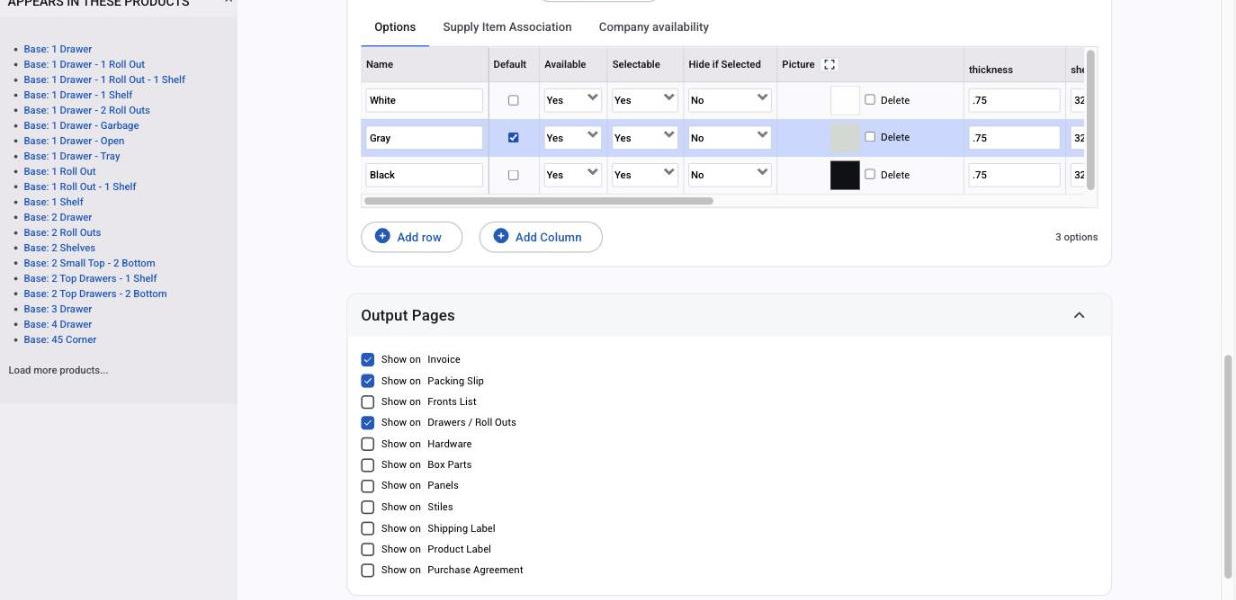
A select attribute's options live in a table on the attribute. Each option has a Name, a Default flag (one option per attribute), Available (shown in the dropdown or not), Selectable (Yes; Disabled, which shows the option greyed out; or Header, which turns the row into a heading that groups the options below it), Hide if Selected (keeps the attribute off output pages when this option is chosen, handy for a standard choice nobody needs to read) and a Picture.
Add Column adds a custom column: a named value each option carries, such as price, thickness or cost_per_sqft. Formulas read it as attribute.column, for example wood_type.price. This is how a dropdown choice drives a price or a part size; see Price by dropdown option.
Options can also be tied to supplies, so that choosing Maple consumes maple from inventory, and limited to certain customers; see Show options to some customers only.
Overrides: change an attribute for one product
Next to every attribute on a product is Edit Overrides. There you can change the default, the limits, the formatting, which options are available, an option's name or price, and who can see each option, for that product only. The attribute itself stays as it was for every other product. See Override an attribute for one product.
Order-level settings
A select or number attribute can be marked Is an Order Level Setting. It then appears in the Order Level Settings panel at the top of the order page, where the customer answers it once and every product added afterwards starts with that answer. See Order-level settings (presets).
Things to know
- An attribute can't be deleted while a product uses it. Remove it from the products first, or leave it; unused attributes do no harm.
- Hidden attributes still work in formulas. Set Order Page Visibility to Hide and the customer can't see or change it, but it needs a default, because that default is what the formulas use.
- Pictures on options show on the order page according to the product's Image position setting: Bottom puts them below the dropdown, Middle above it.
- Custom columns are the price list. Keep a backup of an attribute's options before big edits; see Import and export attribute options.