
To resell another Allmoxy shop's products, turn B2B on for your shop, then in Settings > E-commerce > B2B Settings upload a B2B Logo, tick the box that enables B2B items to be sold in your catalog, choose whether supplier items dropship, and pick your supplier under Connect to B2B Suppliers. You log in to your customer account on the supplier's site (or create one), and the supplier's Catalog Sync page opens so you can import the items you want to sell. From then on they sit in your catalog next to your own products, and your customers order them on your order form.
Applies to: catalog shops (not project-only shops) with B2B turned on. B2B Settings and connecting need the Manage B2B permission; importing items needs Manage Catalog; price adjustments need Manage Financial Settings.
In this article
- Before you start
- Set up B2B Settings
- Connect to a supplier
- Add the supplier's products
- Your B2B catalog
- Output pages and the invoice export
- What the supplier sees of your customer's order
- Things to know
Before you start
Typically you already have a supplier in mind whose products you want to resell. Build that relationship first: agree the product offering and the pricing with your supplier before setting up your B2B catalog.
Then check four things:
- B2B is on. Reach out to your Customer Success Manager, through Allmoxy's support chat or at support@allmoxy.com, to request B2B be turned on. Once it is, you will see two new entries under Settings > E-commerce: B2B Settings and B2B Catalog.
- Your supplier is ready. The supplier has B2B on and allows resellers: Set up B2B as a supplier. Otherwise you'll see "...is currently not accepting B2B connections".
- Currencies match. Your shop's default currency must be set and must match the supplier's; a shop with no default currency can't connect, and mixed currencies are refused.
- You are signed in as a normal user with Manage B2B, not your site's main administrator account. Connecting as the administrator is refused ("You cannot register the local administrator account").
How the two shops work together is in Guide: Sell through other Allmoxy shops (B2B vertical catalog).
Set up B2B Settings
- Go to Settings > E-commerce > B2B Settings.
- Upload a B2B Logo. This distinguishes you in the list of companies in B2B connections, and it is required when your B2B catalog is on and your site has no logo of its own.
- Tick the box "Enable B2B items to be sold in my catalog". With this on, any of your suppliers' products you choose to add to your catalog are available for sale; with it off, resold items stay out of your catalog.
- Decide on dropshipping with the "Use Dropshipping for B2B orders" box. Tick it if you want suppliers' products to ship from the supplier straight to your customer; leave it unticked if you want them to ship to you first, so you ship to your customer. More on B2B shipping: Guide: Shipping in Allmoxy.
- If you want the supplier's product attributes available as order level settings on your orders (material or finish picked once per order), tick "Sync B2B Supplier order level settings". They are synced each time you import; the rest of that setup is on Use a supplier's attributes as order level settings.
- Save. The Resynchronize B2B attributes now button under the boxes pulls your suppliers' attributes again without waiting for the next import.
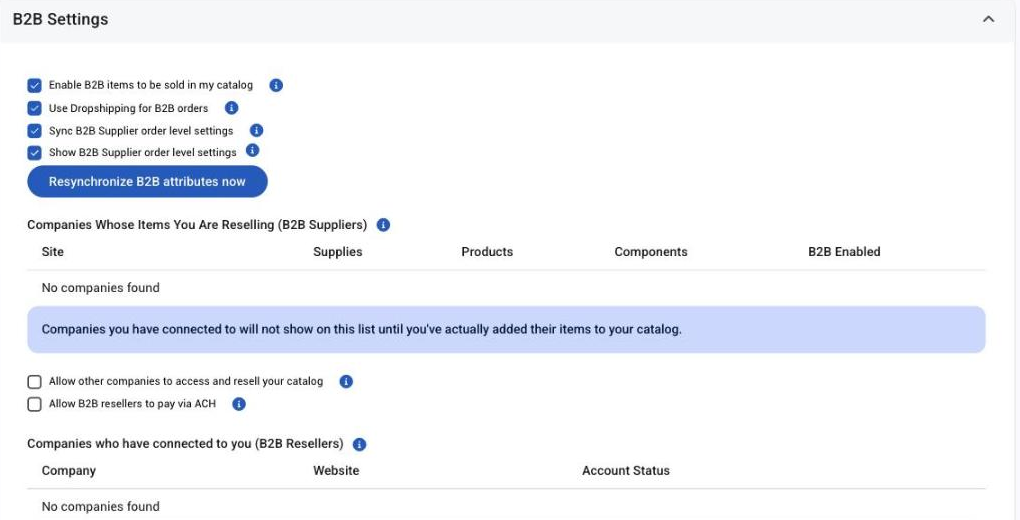
Below the settings is a section listing the companies whose items you are reselling (your B2B suppliers). It fills in as you connect to suppliers and include their products in your catalog. The Show B2B Supplier order level settings box on this page does nothing today. Auto discontinue is not a box here: when it is turned on for your shop, Allmoxy switches off a resold item the supplier has withdrawn or couldn't return during an outage, and you reactivate such items in My B2B Catalog.
Connect to a supplier
Now you're ready to connect to your first supplier.
- On B2B Settings, scroll down to Connect to B2B Suppliers and click the company whose products you want to resell. The list shows the Allmoxy shops that allow resellers.
- You are prompted to either log in to your existing customer account with the supplier or create a new customer account with them. Logging in links the account you already have; creating one adds a company and contact for you on the supplier's site, starting with the supplier's default finance charge, order limit and credit limit and card payments only.
- Once logged in, the supplier's Catalog Sync page opens with the products the supplier has made available for resale (next section).
The connection is now made, and it can't be undone from the app. On the supplier's side you are a customer company, and every order you place with them is recorded under your company and its primary contact there. Ask the supplier to give that company a default billing address, a shipping address if your orders don't dropship, a primary contact who can submit orders and make payments, and the payment term and order limit you agreed; those decide whether your orders go through.
Add the supplier's products
On the supplier's Catalog Sync page you'll see all the products the supplier allows you to resell. The short version:
- Tick the box on each product you want to sell. The box has three states: ticked imports the item (or reactivates one you deactivated), empty deactivates an item you already imported, and crossed out deletes it from your catalog.
- Click Edit on an item to choose the category in your catalog you'd like it to appear in (keep the supplier's category, create a new one, or pick one of yours).
- To mark the items up as they come in, turn on Generate New Price Adjustments and enter a percent or flat amount. This creates one adjustment per checked item, including items already in your catalog that are left checked, and they add up on every sync, so read the warning on the page.
- Tick the box to agree to the agreement regarding reselling items, then click Sync and Resell Catalog to save.
The full steps, with hiding and deleting items and pricing them afterward, are on Resell a supplier's products: add, hide and price B2B items. You can come back to the Catalog Sync page any time from B2B Catalog (Add Items) to add more.
Your B2B catalog
You can view all of your B2B products at Settings > E-commerce > B2B Catalog (My B2B Catalog). The list shows each item's product name, type, origin (the supplier) and status (currently offered, or discontinued).
Click a product name and it opens much like a product in your own catalog, but as a reseller you control only part of it: whether it is available in your catalog, its sort, its export class, its tags and its categories. Everything else (the attributes, parts, tables and base pricing) belongs to the supplier and is read-only. A resold product shows a reduced set of tabs (Attributes, Pricing and Help Info on older screens), and tabs with no supplier content are hidden. B2B tags are kept with the item and are not linked to your other product tags.
The Pricing tab shows only your own reseller price adjustments for this product. Until one applies, you are selling the item at your cost (the supplier's price to you). You can click into and edit an adjustment from here, but new ones are created on Settings > Operations > Price Adjustments: Price adjustments.
Output pages and the invoice export
Resold items show up on your output pages with limited information, read live from the supplier. If you don't want them on a particular output page (a door cut list, for example), open the page under Settings > E-commerce > Output Pages and use its setting to hide B2B items; an output page can also be set to show only when an order has B2B items. More on output pages: Guide: Output pages.
B2B items you sold also appear in your Invoices Export Queue, with the item name, the export class you assigned to the item, and the price you sold it for. Those lines are fetched from the supplier when you export; if the supplier can't be reached at that moment, those lines are left out of the export, so check the file against the invoice when a supplier has been down.
What the supplier sees of your customer's order
When your customer's order includes a supplier's items, the supplier gets its own order for just those items, at Bid, and it is recorded under your company and primary contact on the supplier's site, billed to your company's default billing address there. Along with its lines, the supplier receives the order's non-item details: the order name (carrying your order number), the order-level settings and the shipping details, so it can ship or dropship. Your customer has no account on the supplier through you and can't bypass you to order from the supplier directly unless they set up their own account there.
When you verify your order, the supplier's order moves to Ordered and they build it. After that, you move your own order; the supplier's status changes aren't copied onto it, and you can read their status on the order's B2B tab. The whole flow, including pay-first suppliers and order limits, is in Guide: Sell through other Allmoxy shops (B2B vertical catalog).
Things to know
- Sold at cost until a price adjustment applies. The Pricing tab of every resold item tells you so; set one up as you import or afterward.
- Your order page waits on the supplier. Supplier items are loaded live on every view and save. If the supplier is slow or down, they show "Unable to retrieve data" and the order can't be placed until the supplier is back.
- Auto discontinue can switch items off. Items the supplier withdrew, or couldn't return during an outage, are deactivated; reactivate them in My B2B Catalog once the supplier is back.
- A pay-first supplier is paid from your saved method on their site. Your customer pays you first; if the charge to the supplier then fails, your order drops back to Bid and your owner gets an announcement naming the supplier. Fix your saved payment method on the supplier.
- You can pay a supplier's invoices from your own site. With Manage Financial Settings, open the supplier's company page to see and pay your open invoices there and view receipts.
- A connection can't be undone, remakes don't include supplier items, and both shops must keep the same default currency.