
Allmoxy looks the sales tax rate up for every order, but some customers need something else: a reseller or non-profit with a tax exemption certificate, a customer with a unique tax situation, or a shop that doesn't charge tax at all. The Custom Tax Rate on a customer's company replaces the looked-up rate on every order they place, and a rate of 0 makes them tax exempt. This article shows where the field is, how to keep the exemption on file, and the two related switches: the Canada PST exemption and the per-order override.
Applies to: shops charging sales tax. The Custom Tax Rate and Canada PST Exempt fields are in the Financial Settings section of the company form, which needs the Manage Financial Settings permission. Overriding the rate on one order needs Manually Edit Orders. How the normal rate is worked out is in Sales tax: where you collect it and how Allmoxy works out the rate.
In this article
- Give a customer a custom tax rate
- Keep the exemption on file
- Charge no tax at all
- Canadian customers who don't pay PST
- Override the tax on one order
- Things to know
Give a customer a custom tax rate
- Open the customer's company (Customers > Companies) and edit it.
- In the Financial Settings section, find Custom Tax Rate.
- Enter the rate the customer should pay as a percentage. If the customer is tax exempt, enter 0. If they have a unique tax situation, enter their rate.
- Save the company.
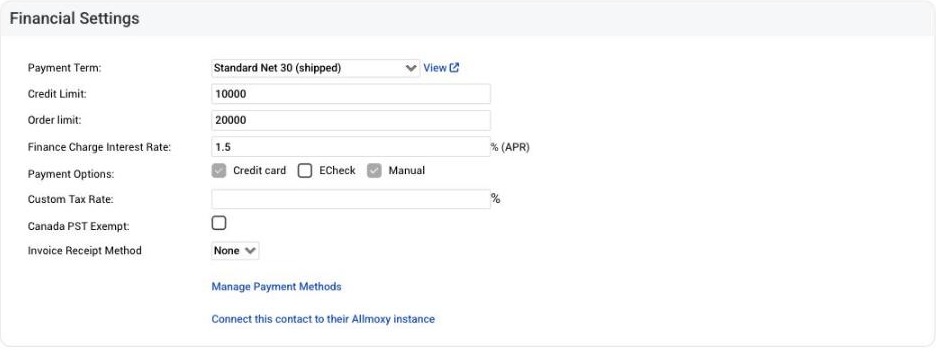
From then on, every order for that company uses this rate instead of the looked-up one, wherever it ships from or to, and the order page no longer offers a jurisdiction breakdown for it. Orders that are already open keep the rate they were saved with until they are saved again, so re-save any open bids after you change the field. A Shipped order is frozen and does not change.
A custom rate replaces the rate, not what is taxable: exempt products, supplies and B2B items are still counted the same way, and shipping is still taxed or not as the lookup decided. Leave the field empty to go back to looked-up rates.
Keep the exemption on file
Tax-exempt customers are required to provide proof of their tax exemption, and that status usually comes with a tax-exempt ID. Keep it in Allmoxy so the 0 rate is never a mystery later:
- Add a custom field on companies, such as Tax Exempt #, and fill it in (custom fields show in the Extra Information section of the company form). You can also put the field on your customer sign-up form so new business accounts give you the ID up front.
- Or add the ID in a note on the company, or attach a copy of the certificate to the company: Use notes, tasks and announcements.
Allmoxy's rates are real-time, rooftop-level rates. If a looked-up rate looks wrong, contact your Customer Success contact before hardcoding a custom rate to work around it; see Troubleshoot a sales tax rate first.
Charge no tax at all
Allmoxy only charges tax in the states and provinces on your Sales Tax Presence list, so the simplest way to charge no tax is to leave the list empty. That shows your employees a warning on every order page, though, and it is not what we recommend.
If you nonetheless want every order tax free, set every customer's Custom Tax Rate to 0.00%. Each time you add a new company, you will have to edit this field on it too; a new sign-up starts with no custom rate and is taxed normally.
Canadian customers who don't pay PST
For a Canadian customer who is exempt from provincial sales tax but still pays GST, don't use a custom rate: tick Canada PST Exempt in the same Financial Settings section of the company form. Their orders in GST plus PST provinces are then charged GST only, and the GST line is the only tax line on the order. The GST and PST tags for your output pages are in Canadian shops: GST, PST and HST.
Override the tax on one order
An employee with Manually Edit Orders can type a rate straight onto an order: click the rate percentage shown next to the tax line on the order page (its tooltip says Click to edit tax rate; a Canadian order has GST and PST rates) and enter the override while the order isn't Shipped. An override wins over everything, including the company's custom rate, and is never replaced by a later lookup; an icon next to the rate removes it. Overrides can't be entered on Shipped orders, and the fields don't appear on B2B guest orders. When an order is converted to an itemized order, its current rates are copied into the override fields so later edits don't change them.
Products that are never taxable are better handled on the product, with Exempt from sales tax on the product form, so no one has to remember per order.
Things to know
- 0 means exempt. An empty Custom Tax Rate means "look it up"; 0 means "charge nothing".
- A custom rate follows the company, not the contact. Every contact at the company gets it on every order.
- Re-save open orders after changing the field; Shipped orders keep their tax.
- Made exempt after an order was placed? Set the Custom Tax Rate to 0, then open the order and save it so it picks up the new rate (an order at Verified or later needs Edit Verified Orders). If the customer already paid the tax, the invoice now shows more paid than it owes: refund the difference in your Stripe dashboard, or give them a credit memo for it. The Sales Tax report reads the rate saved on each order, so it shows no tax for that order once it's saved.
- Keep the certificate. A custom field or an attachment on the company is enough to answer an auditor.
- An order override beats the custom rate. If a company with a custom rate shows a different rate on one order, look for an override on that order.
- The tax code on a custom-rate order is your own state for will call orders and the destination state otherwise, so the Sales Tax report and the accounting export still group it sensibly.