
Allmoxy talks to your other software in a handful of ways: order files in (the Importer, the CSV importer), files out to saws, CNCs and design software (exporters), the API for anything a developer builds, Zapier and webhooks for events, accounting exports, live UPS and FedEx rates, email from your own domain, a chat widget on your portal, and B2B between two Allmoxy shops. This guide gives a paragraph on each, the route for the products shops ask about most, and a link to the steps. Most screens live under Settings > Integrations.
Applies to: every Allmoxy shop. The entries under Settings > Integrations (API, Accounting, Messaging, Extensions and Zapier) each show only to people with the matching permission: Manage Integrations, Manage API key or View API key, Manage Accounting, Manage Sendgrid, Manage Extensions, and Manage Zapier key or View Zapier key. The Importer, exporters and B2B are for catalog shops, not project-only shops.
In this article
- Bring order files in: the Importer and Import Order (Legacy)
- Send orders to machines and design software: exporters
- Build your own connection with the API
- Automate with Zapier and webhooks
- Send invoices and payments to accounting
- Get live shipping rates from UPS and FedEx
- Send email from your own domain with SendGrid
- Add a chat widget to your portal
- Software shops connect, and the route for each
- Sell through other Allmoxy shops (B2B)
- Things to know
Bring order files in: the Importer and Import Order (Legacy)
The Importer (Orders > Importer) reads the file as it is (a Cabinet Vision ORDX, a zipped Mozaik job, XML or text exports, a PDF, or a photo of a handwritten order), matches each line to a product in your catalog and each detail to its attributes, shows you the matches to confirm, then creates the order. Steps: Import an order from a design file with the Importer.
Orders > Import Order (Legacy) reads a CSV file built to your catalog's template, for example a cut list exported from Cabinet Vision, and opens a new order with those lines filled in. CSV files still go this way. Steps: Import an order from a CSV file (Import Order Legacy).
Companies, contacts, supplies and old invoices come in through Settings > Utilities > Import instead: Import data into Allmoxy.
Send orders to machines and design software: exporters
Allmoxy can export almost any piece of data related to an order. An exporter is a file definition (CSV, XML or plain text, with the extension your software wants: .csv, .ord, .ordx or .xml) plus a part export formula on each product. The file is built for every order and waits under Send To on its output pages. Allmoxy does not produce CNC machine code itself; it writes the file your nesting, optimizing or design software reads. Exporters live at Settings > Operations > Exporters.
- How to build one: Exporters: send part data to your machines and software; starting points for common packages: Export files for nesting and design software.
- Find the file on an order: Find and save an export file.
- Cabinet Vision both ways, with the catalog packages: Cabinet Vision and Allmoxy: send orders both ways.
Build your own connection with the API
Need to get more data out of Allmoxy, or integrate two systems? With the Allmoxy API and the help of an API developer you can build datasets customized to your business. The API is an add-on that comes with a sandbox (test) site; ask your Customer Success Manager or support@allmoxy.com. Without it, Settings > Integrations > API shows the sign-up page instead of your credentials.
Setup means generating your shop's Client ID and Client Secret and giving the integration its own contact key with only the access it needs: Set up API access: Client ID, contact keys and test tokens. If the other system can't accept some of your attribute names: Give an attribute a different name for an integration (API Mapping Name).
Automate with Zapier and webhooks
Zapier moves data in and out of Allmoxy without a developer. Create a Zapier account, then accept the invitation from our developers to reach Allmoxy's app inside Zapier: Connect Allmoxy to Zapier and build your first Zap. Your triggers and Zapier hooks then send events (new companies, order status changes, invoices, payments and more) to whatever else you use.
- What each event carries: Zapier triggers and the data each one sends.
- A webhook is a trigger action that sends one event's data to a web address you choose: Send order data to another app with a webhook.
- The bigger picture: Guide: Automation in Allmoxy.
Send invoices and payments to accounting
Allmoxy hands your financial records to your accounting software in two ways. QuickBooks Online has a direct connection at Settings > Integrations > Accounting. Once connected, Allmoxy copies estimates, invoices and payments into QuickBooks Online on its own; no Zapier needed. Steps: Guide: Set up the QuickBooks Online integration.
Everything else uses the export queues under the Financial menu (invoices, sales orders, credit memos and payments not yet sent): tick the records, download a CSV file, import it and clear the queue. That is the route for QuickBooks Desktop (for example through Transaction Pro), Xero, Sage and any package that takes a CSV. There is no direct Xero connection. See Guide: Send invoices and payments to your accounting software, The export queues and what is in the invoice CSV and Guide: Getting paid in Allmoxy.
Get live shipping rates from UPS and FedEx
Allmoxy can ask UPS or FedEx for a rate while a customer builds an order. For UPS, create a UPS developer account, then enter its Client ID and Client Secret, your UPS account number and your max weight per package in the UPS section of Settings > Shipping. In the UPS developer portal, Allmoxy appears under My Apps; add the Rate Calling product to that app, since it is what sends the order's details to UPS. UPS methods can't be switched on until the credentials are saved; then tick Active on each you offer. We typically see shops use UPS Ground and UPS Freight. FedEx and FedEx Freight work the same way with a REST client ID and secret (freight also needs a ship-from address, class and max weight per pallet).
The result is an estimate, not a perfect costing: Allmoxy splits the order's total weight into packages of no more than your max weight per package (more than 50 is refused), sends no package dimensions, and asks for a rate from your ship-from address to the ship-to address. Rates work for US and Canadian destinations only, an order with no weight gets no rate, and a failed carrier call saves the order's shipping as $0 with no warning.
Steps: Connect UPS or FedEx shipping rates. How charges are worked out: Shipping calculations.
Send email from your own domain with SendGrid
With a SendGrid account of your own you can whitelabel your Allmoxy emails so they come from your domain: enter your domain name and your SendGrid API key at Settings > Integrations > Messaging (needs Manage Sendgrid). With either missing, Allmoxy keeps using its own service. Setup: Ensure your Allmoxy emails send properly.
Add a chat widget to your portal
A chat widget gives your customers a direct line to your office or sales team from inside Allmoxy. Go to Settings > Integrations > Extensions (needs Manage Extensions), pick your chat service from the list (ChatBot, Freshdesk, HubSpot, Intercom, LiveChat, Sendinblue, Tawk.to, Tidio, Zendesk or Zoho) and enter the chat API key your service gave you. The chat bubble then shows on every page except the support page; clearing the key removes it.
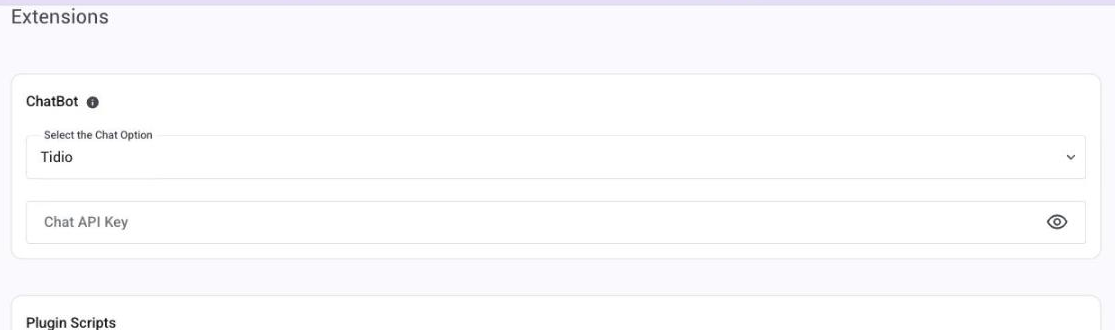
Helpful hint: some chat services also need a widget ID. If the key doesn't work right away, look up the widget ID in your chat service and add it to the end of the key with a / between: a key of abc123 and a widget ID of xyz789 is entered as abc123/xyz789.
The same page has a field for custom plugin scripts. Custom scripts are not supported: we can't help with code entered there, and updates may break it without notice. For analytics, CRM or other connections, use the chat widget, Zapier or the API.
Software shops connect, and the route for each
All connections require initial configuration, and any costs on the other software's side are yours.
- ClosetPro: export your designs from ClosetPro and bring them into Allmoxy. Build your design catalog in ClosetPro first, then mirror it in Allmoxy. The Importer reads XML, text and PDF exports; a CSV goes through Import Order (Legacy).
- 2020 Design Live: a direct design-to-order connection through the API (see Set up API access: Client ID, contact keys and test tokens).
- Cabinet Vision: send any order to Cabinet Vision for machining as a .ord (or .ordx) file through an exporter, and bring a Cabinet Vision order in through the Importer (ORDX) or as a CSV cut list. New to Cabinet Vision? We offer a Cabinet Vision catalog built to match Allmoxy's template catalog as a starting point: Cabinet Vision and Allmoxy.
- CutRite: export your order to CutRite for optimization and machining through an exporter (a starting point is on the export files page).
- RazorGauge (RazorGage): export information specific to the products on your orders for accurate machining (an exporter).
- Microvellum: export your order to Microvellum as XML through an exporter (a starting point is on the export files page).
- Mozaik: export order information to Mozaik through a simple CSV. Mozaik accepts limited catalog information, so some manual adjustments are required. Mozaik job folders come in through the Importer as a .zip.
- NetSuite: export order information at any point, through an exporter or a CSV, to keep running through NetSuite's ERP.
- QuickBooks: the direct connection for QuickBooks Online; the CSV queues for QuickBooks Desktop.
- Sage: a customizable CSV from the export queues to import into Sage products.
- Xero: the CSV export queues; there is no direct connection.
Sell through other Allmoxy shops (B2B)
B2B connects two Allmoxy shops: a supplier lets other shops resell its products, and a reseller adds them to its own catalog, with each order creating a matching order on the supplier's site. The overview: Guide: Sell through other Allmoxy shops (B2B vertical catalog).
Things to know
- Settings > Integrations shows only the entries you have permission for. Ask your administrator for the rest.
- Regenerating your Client Secret cuts off every integration at once. Each needs the new secret before it works again.
- There is no direct Xero connection. Only QuickBooks Online connects directly; everything else works from the CSV export queues.
- A failed carrier call saves the order's shipping as $0 with no warning; rates work for US and Canadian destinations only.
- Custom plugin scripts are unsupported and can break on updates. Use the chat widget, Zapier or the API.
- Every connection needs setup on both sides. The other software's own setup and costs are yours.